
Compliance
Your guide to the UK regulatory landscape.
Understanding UK Fire Safety Regulations
UK Fire Safety Legislation can be classified into 2 major legislative pillars:
1
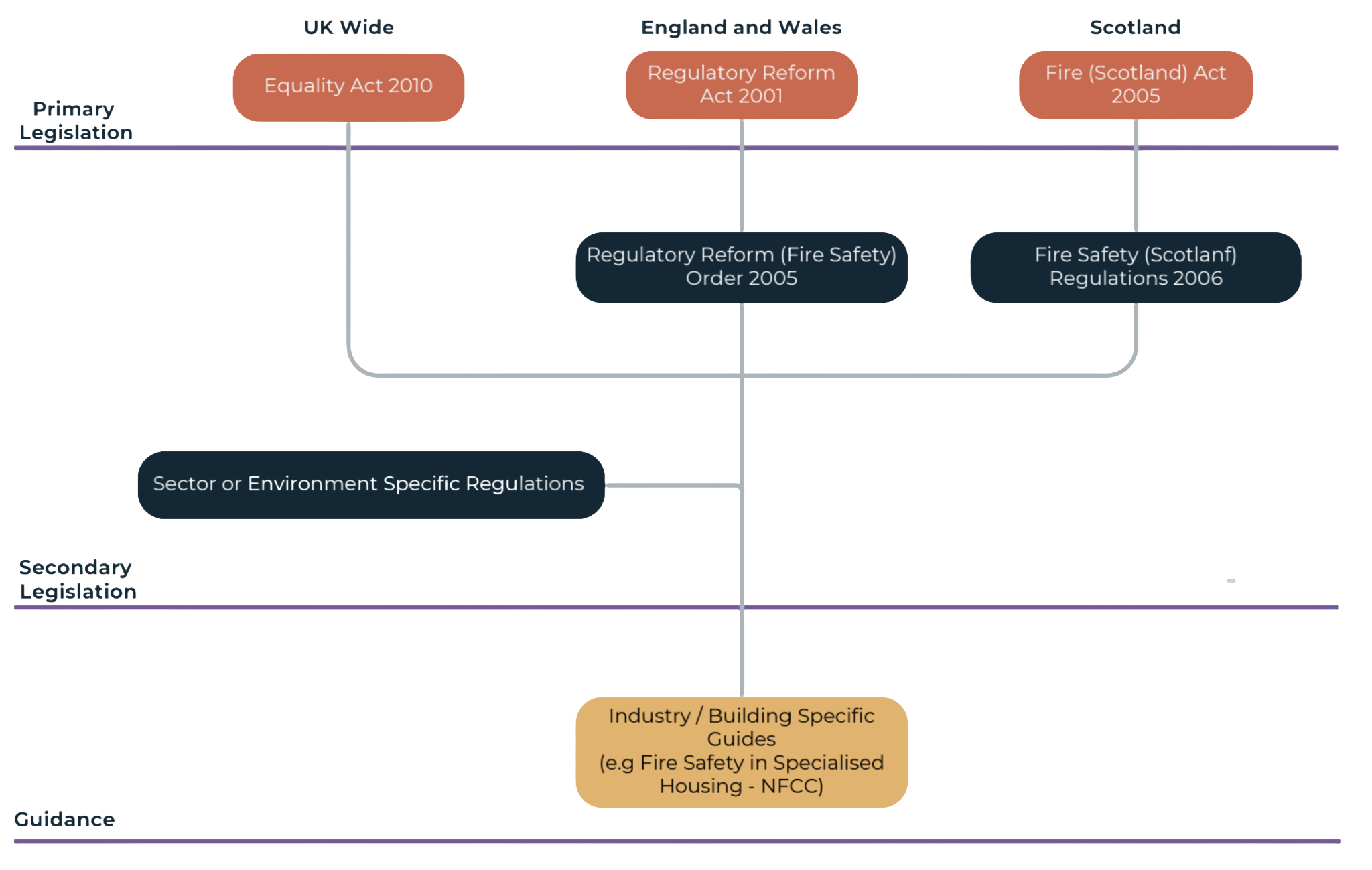
Fire Risk Management for Occupied Buildings and Infrastructure - Ensuring compliance with the Regulatory Reform (Fire Safety) Order 2005, the Fire Safety (Scotland) Regulations 2006, and other relevant statutory requirements.
2
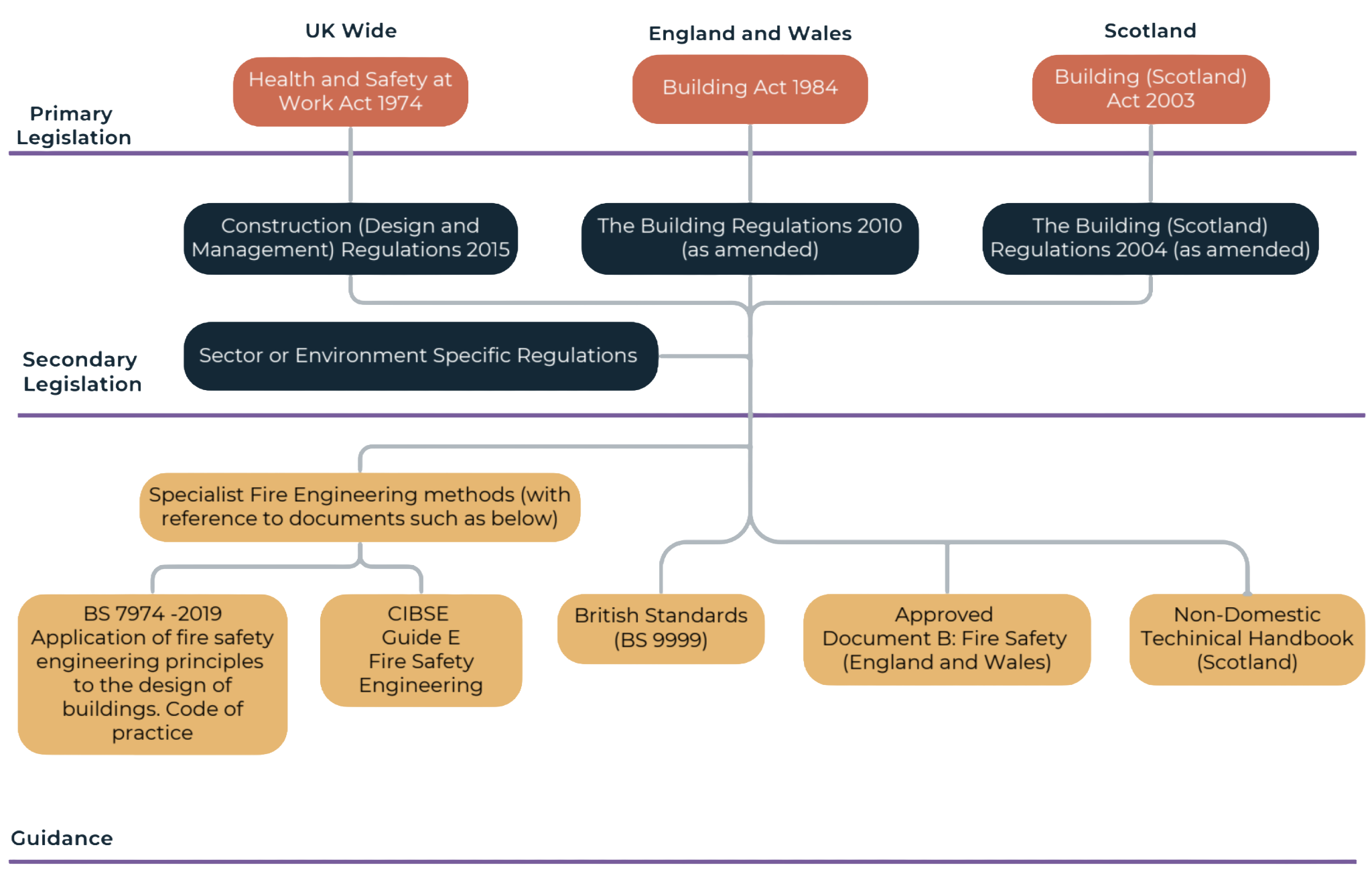
New, Altered and Extended Buildings must comply with UK Building Regulations. Compliance is achieved through Approved Documents, Industry Standards or Fire Engineering Solutions.
Legislative Framework for Occupied Buildings and Infrastructure
-
The RRFSO is the main legislation governing fire safety in England and Wales. It applies to workplaces and common areas of buildings with two or more domestic premises.
Under the RRFSO, the Responsible person (RP) must comply with the Articles of the Order. Duties include:
General Fire Precautions
The responsible person has a duty to implement the preventive and protective measures which have been evaluated in the risk assessment.Fire Risk Assessment (FRA)
The responsible person must make a suitable and sufficient assessment of the risks to which relevant persons are exposed to. Fire hazards and people exposed to risk are to be identified, the FRA should be recorded along with the findings, and it should be reviewed regularly.Principles of Prevention to be Applied
The principles are—
(a) avoiding risks;
(b) evaluating the risks which cannot be avoided;
(c) combating the risks at source;
(d) adapting to technical progress;
(e) replacing the dangerous by the non-dangerous or less dangerous;
(f) developing a coherent overall prevention policy which covers technology, organisation of work and the influence of factors relating to the working environment;
(g) giving collective protective measures priority over individual protective measures; and
(h) giving appropriate instructions to employees.Fire Safety Arrangements
The responsible person must make and give effect to such arrangements as are appropriate, for the effective planning, organisation, control, monitoring and review of the preventive and protective measures.Elimination or Reduction of Risk from Dangerous Substances
Where a dangerous substance is present in or on the premises, the responsible person must ensure that risk to relevant persons related to the presence of the substance is either eliminated or reduced so far as is reasonably practicable.Fire-Fighting and Detection
The responsible person must provide the premises with appropriate fire-fighting equipment, detectors, and alarms, as necessary, and ensure escape routes have adequate emergency lighting in case of normal lighting failure.Procedures for Serious and Imminent Danger
The responsible person must establish and, where necessary, give effect to appropriate procedures, including safety drills, to be followed in the event of serious and imminent danger to relevant persons. A sufficient number of competent persons must be nominated to implement those procedures in so far as they relate to the evacuation of relevant persons from the premises.Maintenance
The responsible person must ensure that the premises and any facilities, equipment and devices provided in respect of the fire safety measures are maintained.Safety Assistance
The responsible person must appoint one or more competent persons to assist him in undertaking the preventive and protective measures.Provision of information to employees
The responsible person must provide employees and contractors with comprehensible and relevant information on the risks to them identified by the risk assessment, the preventive and protective measures, and the fire safety procedures.Training
The responsible person must ensure that his employees are provided with adequate safety training.Co-operation and Co-ordination
Where two or more responsible persons share, or have duties in respect of the premises, each Responsible Person must co-operate with the other responsible person concerned so far as is necessary to enable them to comply with the requirements and prohibitions imposed on them by the RRFSO. -
Following the Grenfell tragedy, existing legislation has changed with the introduction of the following:
-
From the 1 October 2023, Section 156 of the Building Safety Act 2022 introduced changes to The Regulatory Reform (Fire Safety) Order 2005 that affects all Responsible Persons. These adjustments aim to enhance fire safety in non-domestic properties and in any properties housing two or more domestic residences (referred to as multi-occupied residential buildings).
A summary by London Fire Brigade:
Changes to fire safety law: how it affects you | London Fire Brigade (london-fire.gov.uk)
More detail is available here:
-
The Fire Safety (England) Regulations 2022 implements recommendations from the Grenfell Tower Inquiry Phase 1 report. They aim to enhance fire safety in blocks of flats (Specifically, in High-Rise Residential Buildings (18m+ or 7+ storeys) and Multi-Occupied Residential Buildings (Over 11m)) while being practical and cost-effective for individual leaseholders. It predominantly includes flat front doors and external facade of the multi-occupied building within the scope of the RRFSO.
Legislative Framework for New, Altered
and Extended Buildings
-
UK Building Regulations impose legal requirements on building developers and owners to meet minimum standards of building fire design.
There are 3 routes to meeting Building Regulations:
Gov Approved Documents (e.g. Approved Document B) or Technical Handbooks
British Standards (e.g. BS 9999, BS 9992, BS 9991)
Fire Engineering Solutions (e.g. BS 7974, CIBSE Guide E)
Depending on your building or infrastructure, we will determine the best route to meet Building Regulations Compliance. It requires a Competent Person to establish the correct route.
-
Achieving Compliance Through Fire Engineering
Due to their complexity and design, some buildings and infrastructure might not be able to follow prescriptive guidance like Approved Document B, Technical Handbooks, and British Standards. In these circumstances, suitable and sufficient fire safety and compliance with Building Regulations can be achieved through Fire Engineering.
Fire Engineering is the use of scientific and engineering principles, codes and professional judgement to protect people, property and the environment from the adverse effects of fire.
Fire-Engineered Solutions are bespoke to each building and rely on competent and experienced Fire Engineer to assess building design, features and associated hazards, apply fire engineering principles and their personal judgement to propose suitable and sufficient fire safety solution.
Fire Engineering can be particularly beneficial for large, complex and/or multi-use sites:
Railway stations
Airports
Shopping centres
Industrial facilities
Other non-standard buildings

We Are Here To Help You Achieve Compliance
We can help you navigate UK Fire Safety regulations by looking at overarching legislation and selecting a suite of industry-specific guidance documents and best practice, applicable to your building, and support you in implementing effective fire safety to achieve compliance.